
Are you dealing with the discomfort of knee arthritis? You’re not alone. It affects millions of people around the world, ranging in age.[1]
Fortunately, there are natural approaches to managing the pain caused by this condition; one such approach is osteopathy.
Osteopaths have been utilising a combination of manual therapy and movement exercises to alleviate symptoms associated with knee arthritis for years, leading many patients to notice less pain and improved knee function.[3]
What is arthritis?
Arthritis is a medical condition characterised by inflammation of one or more joints.[2] It can cause pain, swelling, stiffness, and decreased range of motion in the affected joint.[2] The most common type of arthritis is osteoarthritis, caused by wear and tear on the cartilage that cushions the ends of bones in a joint.[2]
Knee osteoarthritis is very common.[1] Your knee endures tremendous strains and extreme stress through twists and turns. It also provides support to your entire body weight without fail. Both knees can be frequently affected by osteoarthritis.[3] Osteoarthritis is commonly only found in one joint however it can be present in multiple.
The most typical signs and symptoms of knee arthritis are pain and swelling.[2] Some therapies could lessen your symptoms or even stop the progression.
The 4 stages of knee arthritis
The most common type of arthritis that affects your knees, osteoarthritis, has four stages:
Minor stage
Stage 1 Indicates that your knee joint has some wear and tear. You are unlikely to feel any pain.
Mild stage
In the mild stage, you may experience pain and stiffness, but there is still enough cartilage to keep the bones from actually touching.
Moderate stage
When you are in the moderate stage, you will experience more pain, particularly when running, walking, squatting, and kneeling. You’ll most likely notice it after extended rest periods (like first thing in the morning). You’re probably in a lot of pain because the cartilage has gotten even narrower, and there are a lot of bone spurs.
Severe stage
The cartilage is nearly gone in severe osteoarthritis. Your knee is stiff and painful, and it may be immobile. Surgery may be necessary.[1]
Common causes of knee arthritis
Experts have identified that arthritis can be caused by genetics, this includes knee arthritis.[2] They predict that there are additional genes that have yet to be discovered. You may have a gene linked to arthritis without knowing it. A virus or injury may also cause knee arthritis.
Though the cause is unknown, some risk factors increase the likelihood of knee arthritis. The following are risk factors for osteoarthritis:
- Injuries: Knee injuries can lead to knee arthritis, recurring injuries increase the likelihood of arthritis.[2]
- Age: Osteoarthritis affects older people more frequently than younger people and children, due to degenerative changes in the body.[1]
- Stress: A lot of stress on your knees from jogging, sports, or working an active job can lead to knee osteoarthritis (also known as wear and tear)
- Weight: Extra weight puts additional strain on your knees.[1]
- Gout: Gout, another type of inflammatory arthritis, can result in osteoarthritis.[2]
- Bone anomalies: You are more likely to develop osteoarthritis if your bones or joints are naturally crooked.[2]
Osteopathic care for knee arthritis
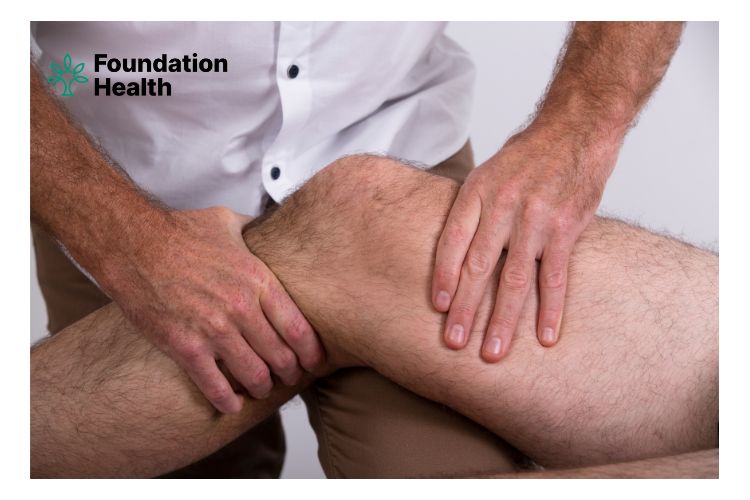
Osteopathy is a natural approach to pain relief and management of knee arthritis. Osteopathic treatments aim to restore balance, mobility and alignment in the body by addressing imbalances in the musculoskeletal system. Osteopaths use gentle manipulative techniques to reduce tension and improve circulation and blood flow to encourage healing.
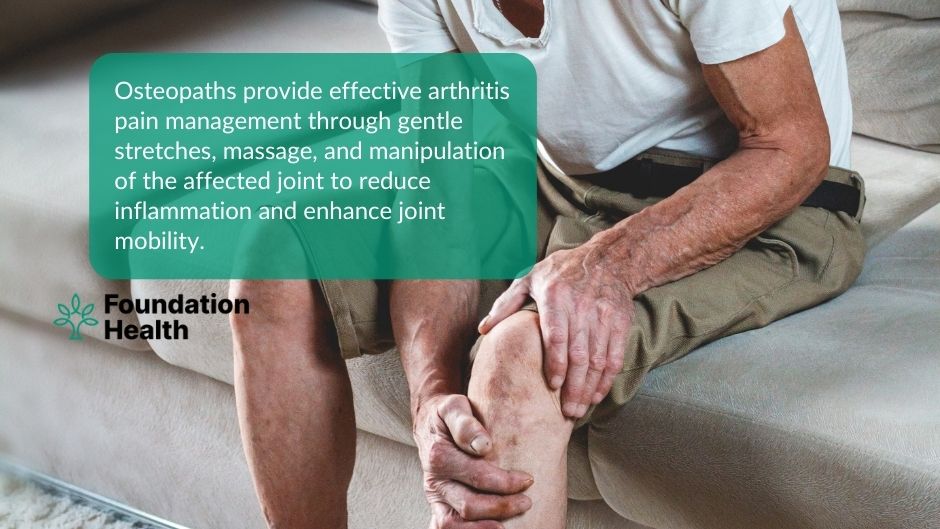
Osteopaths can provide effective arthritis pain management through gentle stretches, and massage of the affected joint to reduce inflammation and enhance joint mobility.
Healthy lifestyle changes such as maintaining a healthy weight and avoiding activities that stress the joints may also be recommended.
Stretches and exercises may also be prescribed to strengthen muscles and improve flexibility.[4] These also keep you moving in between treatments.
Osteopathy can be used to treat pain associated with knee arthritis, but it is important to note that it will not cure the condition.[1] It is best used with conventional treatments, such as medications and lifestyle modifications.[2]
If you suffer from knee arthritis and want to explore natural approaches to managing your symptoms, you should talk to your doctor and an osteopath. An osteopath can develop an individualised treatment plan that meets your needs and can help you manage the pain associated with knee arthritis.
Final thoughts on managing knee arthritis with osteopathy
Osteopathy offers a natural and practical approach to managing knee arthritis pain and improving overall joint health.
Foundation Health Osteopathy provides osteopathic care tailored to your specific condition and needs. Our team of experienced osteopaths will work with you to address the underlying causes of your knee arthritis, so you can find long-term relief and manage your symptoms more effectively.
We provide various services, including manual therapy, therapeutic exercises, and lifestyle advice to help you get back on track.
If you’re struggling with knee arthritis, consider giving osteopathy a try and take the first step towards a pain-free, active life.
Book an appointment at Foundation Health for osteopathic treatment that will assist in managing your knee arthritis.
References
1. Jaimie D Steinmetz; Garland T Culbreth; Lydia M Haile; Quinn Rafferty; Justin Lo; Kai Glenn Fukutaki; Jessica A Cruz; Amanda E Smith; Stein Emil Vollset; Peter M Brooks; Marita Cross; Anthony D Woolf; Hailey Hagins; Mohsen Abbasi-Kangevari; Aidin Abedi; Ilana N Ackerman; Hubert Amu; Benny Antony; Jalal Arabloo; Aleksandr Y Aravkin; Ayele Mamo Argaw; Anton A Artamonov; Tahira Ashraf; Amadou Barrow; Lindsay M Bearne; Isabela M Bensenor; Alemshet Yirga Berhie; Nikha Bhardwaj; Pankaj Bhardwaj; Vijayalakshmi S Bhojaraja; Ali Bijani; Paul Svitil Briant; Andrew M Briggs; Nadeem Shafique Butt; Jaykaran Charan; Vijay Kumar Chattu; Flavia M Cicuttini; Kaleb Coberly; Omid Dadras; Xiaochen Dai; Lalit Dandona; Rakhi Dandona; Katie de Luca; Edgar Denova-Gutiérrez; Samath Dhamminda Dharmaratne; Meghnath Dhimal; Mostafa Dianatinasab; Karsten E Dreinhoefer; Muhammed Elhadi; Umar Farooque; Hamid Reza Farpour; Irina Filip; Florian Fischer; Marisa Freitas; Balasankar Ganesan; Belete Negese Belete Gemeda; Tamiru Getachew; Seyyed-Hadi Ghamari; Ahmad Ghashghaee; Tiffany K Gill; Mahaveer Golechha; Davide Golinelli; Bhawna Gupta; Veer Bala Gupta; Vivek Kumar Gupta; Rasool Haddadi; Nima Hafezi-Nejad; Rabih Halwani; Samer Hamidi; Asif Hanif; Netanja I Harlianto; Josep Maria Haro; Jan Hartvigsen; Simon I Hay; Jeffrey J Hebert; Golnaz Heidari; Mohammad-Salar Hosseini; Mehdi Hosseinzadeh; Alexander Kevin Hsiao; Irena M Ilic; Milena D Ilic; Louis Jacob; Ranil Jayawardena; Ravi Prakash Jha; Jost B Jonas; Nitin Joseph; Himal Kandel; Ibraheem M Karaye; Md Jobair Khan; Yun Jin Kim; Ali-Asghar Kolahi; Oleksii Korzh; Rajasekaran Koteeswaran; Vijay Krishnamoorthy; G Anil Kumar; Narinder Kumar; Sang-woong Lee; Stephen S Lim; Stany W Lobo; Giancarlo Lucchetti; Mohammad-Reza Malekpour; Ahmad Azam Malik; Luiz Garcia Garcia Mandarano-Filho; Santi Martini; Alexios-Fotios A Mentis; Mohamed Kamal Mesregah; Tomislav Mestrovic; Erkin M Mirrakhimov; Awoke Misganaw; Reza Mohammadpourhodki; Ali H Mokdad; Sara Momtazmanesh; Shane Douglas Morrison; Christopher J L Murray; Hasan Nassereldine; Henok Biresaw Netsere; Sandhya Neupane Kandel; Mayowa O Owolabi; Songhomitra Panda-Jonas; Anamika Pandey; Shrikant Pawar; Paolo Pedersini; Jeevan Pereira; Amir Radfar; Mohammad-Mahdi Rashidi; David Laith Rawaf; Salman Rawaf; Reza Rawassizadeh; Seyed-Mansoor Rayegani; Daniela Ribeiro; Leonardo Roever; Basema Saddik; Amirhossein Sahebkar; Sana Salehi; Lidia Sanchez Riera; Francesco Sanmarchi; Milena M Santric-Milicevic; Saeed Shahabi; Masood Ali Shaikh; Elaheh Shaker; Mohammed Shannawaz; Rajendra Sharma; Saurab Sharma; Jeevan K Shetty; Rahman Shiri; Parnian Shobeiri; Diego Augusto Santos Silva; Ambrish Singh; Jasvinder A Singh; Surjit Singh; Søren T Skou; Helen Slater; Mohammad Sadegh Soltani-Zangbar; Antonina V Starodubova; Arash Tehrani-Banihashemi; Sahel Valadan Tahbaz; Pascual R Valdez; Bay Vo; Linh Gia Vu; Yuan-Pang Wang; Seyed Hossein Yahyazadeh Jabbari; Naohiro Yonemoto; Ismaeel Yunusa; Lyn M March; Kanyin Liane Ong; Theo Vos; Jacek A Kopec (2023). Global, regional, and national burden of osteoarthritis, 1990–2020 and projections to 2050: a systematic analysis for the Global Burden of Disease Study 2021. The Lancet Rheumatology. https://doi.org/10.1016/s2665-9913(23)00163-7 ↩
2. David J Hunter; Sita Bierma-Zeinstra (2019). Osteoarthritis. The Lancet. https://doi.org/10.1016/s0140-6736(19)30417-9 ↩
3. Turgay Altınbilek (2018). Osteopathic manipulative treatment improves function and relieves pain in knee osteoarthritis: A single-blind, randomized-controlled trial. Turkish Journal of Physical Medicine and Rehabilitation. https://doi.org/10.5606/tftrd.2018.1384 ↩
4. Marlene Fransen; Sara McConnell; Alison R Harmer; Martin Van der Esch; Milena Simic; Kim L Bennell (2015). Exercise for osteoarthritis of the knee. Cochrane Database of Systematic Reviews. https://doi.org/10.1002/14651858.cd004376.pub3 ↩